
Write On
by Kalela Williams
You Think These are Tough Times for Kids?
If you think wearing a mask is a hardship, try sitting on a hard wooden bench in a bare classroom with no heat or A/C.
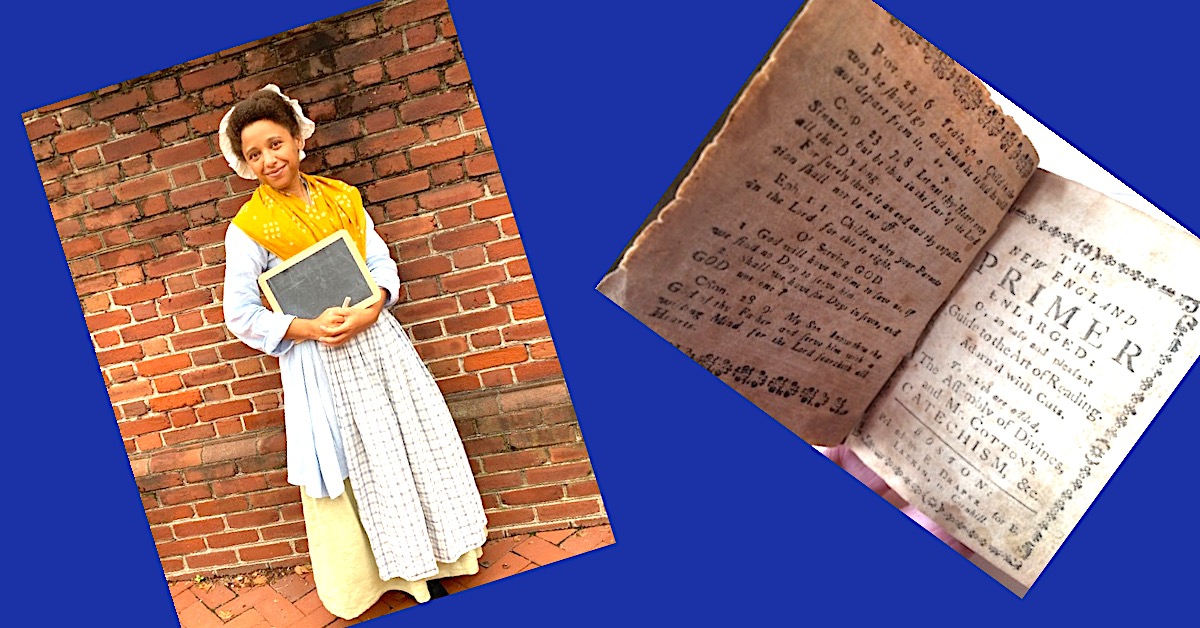
In Adam’s fall
we sinned all.
So begins the alphabet in a 1777 edition of the New England Primer, the most-used textbook in the colonies/United States before the end of the 18th century. Learning the alphabet back then meant memorizing biblical messages like the one above, or rhymes that seem just weird or disturbing, such as:
Whales in the sea
God’s voice obey
Or:
Xerxes the great did die
And so must you and I
Fun stuff, right? Sure, maybe kids hundreds of years ago didn’t exactly enjoy reciting these passages over and over, but I’ve been excited to learn about how they learned. This past August, I spent my weekends portraying an 18th century teacher as part of the Museum of the American Revolution’s Meet the Revolution series, in which costumed living history interpreters explore the experiences of diverse people during the American Revolution.
I took a deep dive into researching education in the 18th century, and I discovered that back then, teachers could really take the “fun” out of fundamental. Besides the doom-and-gloom alphabet, teachers didn’t spare the rod (“the idle Fool is whipt at school,” the primer reads). A teacher might have laid a nice sturdy branch on their desk just as a reminder of the truth in this rhyme. But who wouldn’t want to act up in class? If you thought wearing a mask is a discomfort, try sitting on a hard wooden bench in a bare classroom with no heat or A/C.
I can’t imagine what an 18th century teacher, like the one I portrayed, would think about learning today. For instance, she’d be floored that technology is such an integral part of the classroom, or that today’s technology exists at all. Wooden-framed slates have been replaced by smartboards. For that matter, smartboards are increasingly being replaced by Zoom, what with the Delta variant still keeping many schools in hybrid mode or threatening to send kids home entirely. Virtual learning would kind of put a damper on an 18th century teacher’s preferred method of discipline.
Resources that we take for granted were tough to come by 250 years ago. Paper? It was expensive. Books were a luxury. These items wouldn’t have been “wasted” on children. The teacher would read from the primer and students would recite and memorize.
When kids did get their hands on paper, it was to practice good handwriting. They would often write moralistic phrases over and over again, like “Avoid bad habits.” Today of course, kids often don’t learn cursive, an omission that concerns few others except history nerds like me (because how will they learn to read historical documents)?
Of course, the teacher I portrayed would also be amazed that so many other teachers today are college-educated women. Until around the mid-1800s, teaching was a male dominated profession, and most teachers in the U.S. weren’t very well educated themselves. There were few Black teachers in the 18th century, as well, although in Philadelphia, organizations like the Pennsylvania Abolition Society and people like James Forten, a Black entrepreneur, set up educational institutions for African American kids.
But most African American kids of that time weren’t formally educated at all, because they were enslaved, and teaching enslaved people was either illegal, discouraged, or just not done. Instead, the education of enslaved and poor white children, as well as indigenous kids, might have taken more practical forms. For instance, enslaved boys might have learned agricultural work, but also trapping, hunting, and fishing from male relatives, skills that helped them supplement the rations they were given. Girls might have learned domestic skills, but also how to forage for medicinal plants, or how to plant gardens, so that they be contributing members to their communities.
The fact is, children are always learning.
We’ll have to see how a year of online education— and maybe more— plays out in decades to come. Will a generation of kids have become more withdrawn, finding it more difficult to make friends? Will they have missed out on mastering key skills? And on the other side: will they be more resilient and adaptable than in previous generations? Will they hold more of a sense of community, like old-school kids? Is it possible for a rhyme… like this one?
Somehow the Coronavirus
Has managed to inspire us

Kalela Williams (kwilliams@mightywriters.org) is MW’s Director of Writing.
Stay connected!
Enter your email address below to receive our Mighty updates!
Mighty Writers is a class 501(c)(3) nonprofit organization established in 2009. All of our programs are free. We serve communities in and around Greater Philadelphia and New Jersey.